The aim of the “ECOeDNA” Project is to develop a new research infrastructure that will utilize innovative molecular technologies for the analysis of environmental DNA (eDNA), in terms of recording and monitoring the dynamics and diversity of local fisheries and the marine microbiome.
Traditional methods for monitoring fish habitats and stocks have limitations due to a) sampling constraints, b) heterogeneity and complexity in aquatic systems, c) population dynamics and d) the labor and time required to analyze samples. The various stock assessment models require age-based data on catches and population demographic structure, which are not always available or are inaccurate. Many of the exploited stocks remain limited, unassessed or assessed based on weak assumptions about their structure and delimitation.
For this reason, an innovative, deeper, faster, more accurate and more economical approach is needed for the reliable monitoring of habitats and fish stocks, using cutting-edge technologies, at low cost but with high accuracy and sensitivity. To achieve the assessment of fish stocks, ecotypes, as well as the management of aquatic ecosystem resources, eDNA analysis will be used. eDNA analysis applications now offer usable information for the management of aquatic ecosystem resources, mainly by increasing the speed and accuracy of fish stock and ecotype assessments. eDNA in combination with bioinformatics analyses, can offer a number of advantages to marine monitoring and assessment programs compared to traditional methods, with a very high sample yield/cost ratio.
At the same time, the richness of the microbial community and species present in the aquatic ecosystem will be analyzed, providing a tool for visualizing the diversity of waters. Therefore, the microbiome and eDNA could be used as a sensitive and economical tool for detecting climate change in habitats.
The objective of “ECOeDNA” is:
- To strengthen the existing infrastructure and relevant know-how in order to utilize the microbiome and eDNA analysis for the assessment of ecotypes in aquatic systems.
- To create a biobank.
- To analyze the richness of the microbial community and species present in the aquatic ecosystem through the cataloguing of the genetic material to be detected.
- To use the microbiome and eDNA as a sensitive and economical tool for detecting the impact of environmental and anthropogenic pressures.
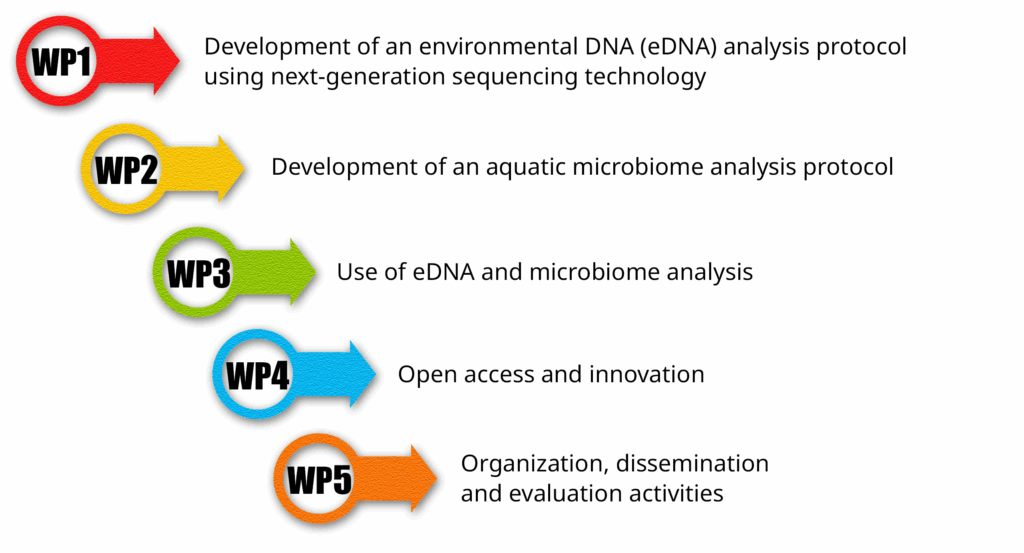
The project is structured into the following work packages (WPs):